Only the border of a 4 × 8 rectangle is drawn with stars. Below you will see how the pattern is built, followed by complete programs in C, C++, Java and Python.
This program is part of the Star Patterns collection.
Hollow Rectangle Star Pattern output
Output (4 rows, 8 columns):
********
*      *
*      *
********
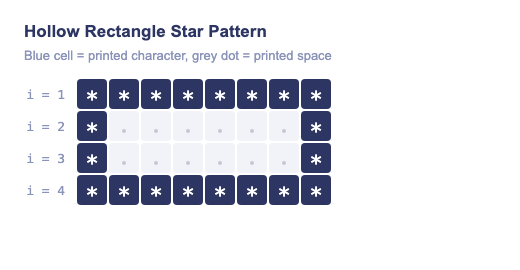
How the hollow rectangle star pattern works
Every row has 2n positions. A star goes in the first and last row, and in the first and last column. Everything else is a space.
- Run the outer loop for
ifrom1ton, one row per pass. - Go through
2 × npositions in the row. Print stars wherei = 1 or i = n or j = 1 or j = 2 × n; print spaces everywhere else. - Move to the next line.
Hollow Rectangle Star Pattern in C
#include <stdio.h>

int main(void) {
    int n = 4;

    for (int i = 1; i <= n; i++) {
        for (int j = 1; j <= 2 * n; j++) {
            if (i == 1 || i == n || j == 1 || j == 2 * n)
                printf("*");
            else
                printf(" ");
        }
        printf("\n");
    }
    return 0;
}
Hollow Rectangle Star Pattern in C++
#include <iostream>
using namespace std;

int main() {
    int n = 4;

    for (int i = 1; i <= n; i++) {
        for (int j = 1; j <= 2 * n; j++) {
            if (i == 1 || i == n || j == 1 || j == 2 * n)
                cout << "*";
            else
                cout << " ";
        }
        cout << endl;
    }
    return 0;
}
Hollow Rectangle Star Pattern in Java
public class HollowRectangleStar {
    public static void main(String[] args) {
        int n = 4;

        for (int i = 1; i <= n; i++) {
            for (int j = 1; j <= 2 * n; j++) {
                if (i == 1 || i == n || j == 1 || j == 2 * n)
                    System.out.print("*");
                else
                    System.out.print(" ");
            }
            System.out.println();
        }
    }
}
Hollow Rectangle Star Pattern in Python
n = 4

for i in range(1, n + 1):
    for j in range(1, 2 * n + 1):
        if i == 1 or i == n or j == 1 or j == 2 * n:
            print("*", end="")
        else:
            print(" ", end="")
    print()
Time and space complexity
The program prints one character for each position in the pattern, so for n rows it runs in O(n²) time. It only needs a few loop variables, so the extra memory is O(1).