The prefixes of the word arranged as a centred pyramid. The logic is explained step by step, and the full program is given in C, C++, Java and Python.
Quick answer: On row i, print n − i spaces and then the first i letters of the word, each followed by a space. Every letter takes two columns, so one space of indent per row centres it, and “PROGRAM” grows into a pyramid from P to P R O G R A M.
This program is part of the String Patterns collection.
Table of contents8 sections
String Pyramid output
Output (s = “PROGRAM”):
      P
     P R
    P R O
   P R O G
  P R O G R
 P R O G R A
P R O G R A M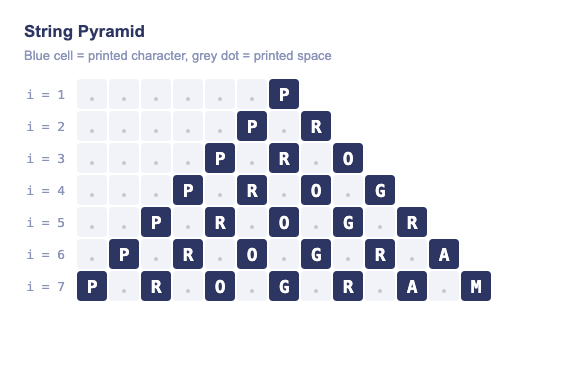
How the string pyramid works
Print n − i spaces, then the first i characters with a space after each one. The extra space after each letter makes the rows centre like a pyramid.
- Run the outer loop for
ifrom1ton, one row per pass. - Print
n − ispaces. - Print
icharacters of the word. - Move to the next line.
Key takeaways
- The letters are a prefix of the word, as in the string right triangle.
- Printing
"%c "makes each letter two columns wide. - One leading space per level is half a letter’s width, which is exactly what centring needs.
- The number of rows is the word length: 7 for PROGRAM.
String Pyramid in C
#include <stdio.h>
#include <string.h>

int main(void) {
    char s[] = "PROGRAM";
    int n = strlen(s);

    for (int i = 1; i <= n; i++) {
        for (int j = 1; j <= n - i; j++)
            printf(" ");
        for (int j = 1; j <= i; j++)
            printf("%c ", s[j - 1]);
        printf("\n");
    }
    return 0;
}String Pyramid in C++
#include <iostream>
#include <string>
using namespace std;

int main() {
    string s = "PROGRAM";
    int n = s.length();

    for (int i = 1; i <= n; i++) {
        for (int j = 1; j <= n - i; j++)
            cout << " ";
        for (int j = 1; j <= i; j++)
            cout << s[j - 1] << " ";
        cout << endl;
    }
    return 0;
}String Pyramid in Java
public class StringPyramid {
    public static void main(String[] args) {
        String s = "PROGRAM";
        int n = s.length();

        for (int i = 1; i <= n; i++) {
            for (int j = 1; j <= n - i; j++)
                System.out.print(" ");
            for (int j = 1; j <= i; j++)
                System.out.print(s.charAt(j - 1) + " ");
            System.out.println();
        }
    }
}String Pyramid in Python
s = "PROGRAM"
n = len(s)

for i in range(1, n + 1):
    for j in range(1, n - i + 1):
        print(" ", end="")
    for j in range(1, i + 1):
        print(s[j - 1], end=" ")
print()Time and space complexity
The program prints one character for each position in the pattern, so for n rows it runs in O(n²) time. It only needs a few loop variables, so the extra memory is O(1).
Frequently asked questions
Why is there a space after every letter?
Without it the letters would be one column wide and the n − i spaces would line the rows up on the right instead of centring them.
How do I use another word?
Change the string s; n = strlen(s) sets the number of rows automatically.
Is it the same idea as the number pyramid?
Yes. The number pyramid uses the same spacing with numbers instead of letters.