Right-aligned triangle that shows the last i characters of the word. This tutorial shows the output, a row-by-row diagram and the complete program in C, C++, Java and Python.
This program is part of the String Patterns collection.
String Suffix Triangle output
Output (s = “PROGRAM”):
      M
     AM
    RAM
   GRAM
  OGRAM
 ROGRAM
PROGRAM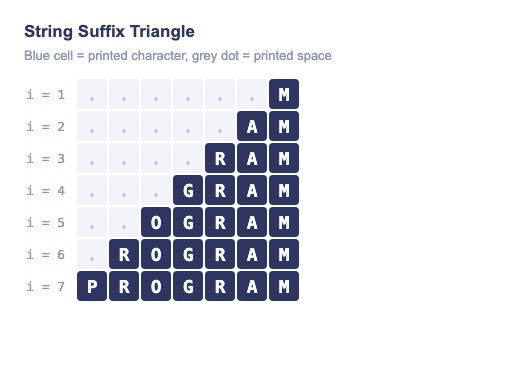
How the string suffix triangle works
The last i characters start at index n − i, so the inner loop prints s[n − i + j − 1] after n − i spaces.
- Run the outer loop for
ifrom1ton, one row per pass. - Print
n − ispaces. - Print
icharacters of the word. - Move to the next line.
String Suffix Triangle in C
#include <stdio.h>
#include <string.h>

int main(void) {
    char s[] = "PROGRAM";
    int n = strlen(s);

    for (int i = 1; i <= n; i++) {
        for (int j = 1; j <= n - i; j++)
            printf(" ");
        for (int j = 1; j <= i; j++)
            printf("%c", s[n - i + j - 1]);
        printf("\n");
    }
    return 0;
}
String Suffix Triangle in C++
#include <iostream>
#include <string>
using namespace std;

int main() {
    string s = "PROGRAM";
    int n = s.length();

    for (int i = 1; i <= n; i++) {
        for (int j = 1; j <= n - i; j++)
            cout << " ";
        for (int j = 1; j <= i; j++)
            cout << s[n - i + j - 1];
        cout << endl;
    }
    return 0;
}
String Suffix Triangle in Java
public class StringSuffixTriangle {
    public static void main(String[] args) {
        String s = "PROGRAM";
        int n = s.length();

        for (int i = 1; i <= n; i++) {
            for (int j = 1; j <= n - i; j++)
                System.out.print(" ");
            for (int j = 1; j <= i; j++)
                System.out.print(s.charAt(n - i + j - 1));
            System.out.println();
        }
    }
}
String Suffix Triangle in Python
s = "PROGRAM"
n = len(s)

for i in range(1, n + 1):
    for j in range(1, n - i + 1):
        print(" ", end="")
    for j in range(1, i + 1):
        print(s[n - i + j - 1], end="")
    print()
Time and space complexity
The program prints one character for each position in the pattern, so for n rows it runs in O(n²) time. It only needs a few loop variables, so the extra memory is O(1).