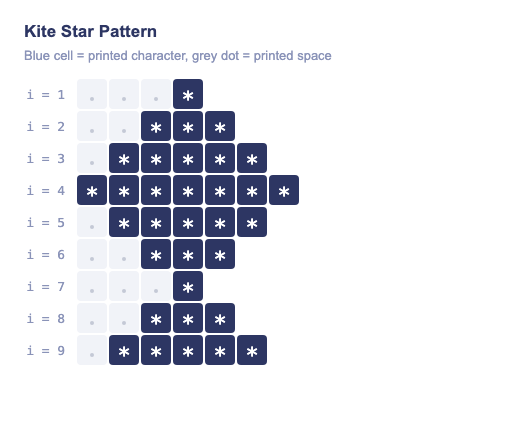
The kite star pattern is a diamond with a short tail hanging from its bottom point. It reuses the diamond star pattern and adds two more rows from the top of a pyramid.
Quick answer: Print the diamond first: a pyramid for rows 1 to n, then rows n − 1 down to 1. Then print rows 2 and 3 of the same pyramid again; they hang under the point and form the tail. Every row uses the same rule, n − i spaces and 2i − 1 stars.
This program is part of the Tricky Patterns collection.
Table of contents8 sections
Kite Star Pattern output
Output (n = 4):
   *
  ***
 *****
*******
 *****
  ***
   *
  ***
 *****
How the kite star pattern works
All three parts of the kite print rows from the same pyramid; they only choose different rows. The upper half counts up to the widest row, the lower half counts back down to a single star, and the tail picks rows 2 and 3 so that it widens slightly under the point. Because each row is built with the same spaces and stars, everything lines up on the centre column automatically.
- Run the outer loop for
ifrom1ton, one row per pass (upper half of the kite). - Print
n − ispaces. - Print
2 × i − 1stars. - Move to the next line.
- Run the outer loop for
ifromn − 1down to1, one row per pass (lower half). - Print
n − ispaces. - Print
2 × i − 1stars. - Move to the next line.
- Run the outer loop for
ifrom2to3, one row per pass (the tail). - Print
n − ispaces. - Print
2 × i − 1stars. - Move to the next line.
Key takeaways
- The kite is a diamond plus a short pyramid tail.
- All three parts print rows of the same pyramid, so they share one centre line.
- Choosing which rows to print, not new formulas, is what changes the shape.
- Start the tail at row 2 so it does not repeat the single star of the point.
Kite Star Pattern in C
#include <stdio.h>

int main(void) {
    int n = 4;

    // upper half of the kite
    for (int i = 1; i <= n; i++) {
        for (int j = 1; j <= n - i; j++)
            printf(" ");
        for (int j = 1; j <= 2 * i - 1; j++)
            printf("*");
        printf("\n");
    }

    // lower half
    for (int i = n - 1; i >= 1; i--) {
        for (int j = 1; j <= n - i; j++)
            printf(" ");
        for (int j = 1; j <= 2 * i - 1; j++)
            printf("*");
        printf("\n");
    }

    // the tail
    for (int i = 2; i <= 3; i++) {
        for (int j = 1; j <= n - i; j++)
            printf(" ");
        for (int j = 1; j <= 2 * i - 1; j++)
            printf("*");
        printf("\n");
    }
    return 0;
}Kite Star Pattern in C++
#include <iostream>
using namespace std;

int main() {
    int n = 4;

    // upper half of the kite
    for (int i = 1; i <= n; i++) {
        for (int j = 1; j <= n - i; j++)
            cout << " ";
        for (int j = 1; j <= 2 * i - 1; j++)
            cout << "*";
        cout << endl;
    }

    // lower half
    for (int i = n - 1; i >= 1; i--) {
        for (int j = 1; j <= n - i; j++)
            cout << " ";
        for (int j = 1; j <= 2 * i - 1; j++)
            cout << "*";
        cout << endl;
    }

    // the tail
    for (int i = 2; i <= 3; i++) {
        for (int j = 1; j <= n - i; j++)
            cout << " ";
        for (int j = 1; j <= 2 * i - 1; j++)
            cout << "*";
        cout << endl;
    }
    return 0;
}Kite Star Pattern in Java
public class KiteStar {
    public static void main(String[] args) {
        int n = 4;

        // upper half of the kite
        for (int i = 1; i <= n; i++) {
            for (int j = 1; j <= n - i; j++)
                System.out.print(" ");
            for (int j = 1; j <= 2 * i - 1; j++)
                System.out.print("*");
            System.out.println();
        }

        // lower half
        for (int i = n - 1; i >= 1; i--) {
            for (int j = 1; j <= n - i; j++)
                System.out.print(" ");
            for (int j = 1; j <= 2 * i - 1; j++)
                System.out.print("*");
            System.out.println();
        }

        // the tail
        for (int i = 2; i <= 3; i++) {
            for (int j = 1; j <= n - i; j++)
                System.out.print(" ");
            for (int j = 1; j <= 2 * i - 1; j++)
                System.out.print("*");
            System.out.println();
        }
    }
}Kite Star Pattern in Python
n = 4

# upper half of the kite
for i in range(1, n + 1):
    for j in range(1, n - i + 1):
        print(" ", end="")
    for j in range(1, 2 * i):
        print("*", end="")
    print()

# lower half
for i in range(n - 1, 0, -1):
    for j in range(1, n - i + 1):
        print(" ", end="")
    for j in range(1, 2 * i):
        print("*", end="")
    print()

# the tail
for i in range(2, 4):
    for j in range(1, n - i + 1):
        print(" ", end="")
    for j in range(1, 2 * i):
        print("*", end="")
print()Time and space complexity
The program prints one character for each position in the pattern, so for n rows it runs in O(n²) time. It only needs a few loop variables, so the extra memory is O(1).
Frequently asked questions
How do I make the tail longer?
Print more rows in the third part, for example rows 2 to 4. For a narrow tail print a single star on each row instead, with n − 1 spaces in front.
Can I print a hollow kite?
Yes. Print a star only at the first and last position of each row, as in the hollow diamond star pattern, and keep the tail solid or hollow.
How do I let the user choose the size?
Read n from the keyboard instead of fixing it in the code: scanf("%d", &n); in C, cin >> n; in C++, new Scanner(System.in).nextInt() in Java and int(input()) in Python.