An arrow head pointing to the left. This tutorial shows the output, a row-by-row diagram and the complete program in C, C++, Java and Python.
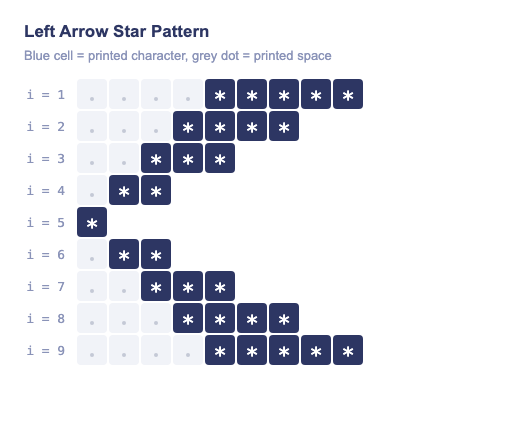
Quick answer: Print two halves. Upper half, i = 1 to n: print n − i spaces and n − i + 1 stars, so the rows shrink towards the left edge. Lower half, i = 2 to n: print i − 1 spaces and i stars. The middle row is a single star at the left edge: the arrow’s point.
This program is part of the Star Patterns collection.
Table of contents8 sections
Left Arrow Star Pattern output
Output (n = 5):
    *****
   ****
  ***
 **
*
 **
  ***
   ****
    *****
How the left arrow star pattern works
The upper half shrinks both the spaces and the stars towards the tip; the lower half grows them again from row 2.
- Run the outer loop for
ifrom1ton, one row per pass (upper half). - Print
n − ispaces. - Print
n − i + 1stars. - Move to the next line.
- Run the outer loop for
ifrom2ton, one row per pass (lower half). - Print
i − 1spaces. - Print
istars. - Move to the next line.
Key takeaways
- In the upper half the spaces and the stars both shrink, so each row also moves left; that slants both sides.
- The lower half mirrors the upper half: rows grow again from 2 stars to
n. - The lower loop starts at
i = 2so the single-star point is printed only once. - The first and last rows reach column
2 × n − 1: column 9 forn = 5.
Left Arrow Star Pattern in C
#include <stdio.h>

int main(void) {
    int n = 5;

    // upper half
    for (int i = 1; i <= n; i++) {
        for (int j = 1; j <= n - i; j++)
            printf(" ");
        for (int j = 1; j <= n - i + 1; j++)
            printf("*");
        printf("\n");
    }

    // lower half
    for (int i = 2; i <= n; i++) {
        for (int j = 1; j <= i - 1; j++)
            printf(" ");
        for (int j = 1; j <= i; j++)
            printf("*");
        printf("\n");
    }
    return 0;
}Left Arrow Star Pattern in C++
#include <iostream>
using namespace std;

int main() {
    int n = 5;

    // upper half
    for (int i = 1; i <= n; i++) {
        for (int j = 1; j <= n - i; j++)
            cout << " ";
        for (int j = 1; j <= n - i + 1; j++)
            cout << "*";
        cout << endl;
    }

    // lower half
    for (int i = 2; i <= n; i++) {
        for (int j = 1; j <= i - 1; j++)
            cout << " ";
        for (int j = 1; j <= i; j++)
            cout << "*";
        cout << endl;
    }
    return 0;
}Left Arrow Star Pattern in Java
public class LeftArrowStar {
    public static void main(String[] args) {
        int n = 5;

        // upper half
        for (int i = 1; i <= n; i++) {
            for (int j = 1; j <= n - i; j++)
                System.out.print(" ");
            for (int j = 1; j <= n - i + 1; j++)
                System.out.print("*");
            System.out.println();
        }

        // lower half
        for (int i = 2; i <= n; i++) {
            for (int j = 1; j <= i - 1; j++)
                System.out.print(" ");
            for (int j = 1; j <= i; j++)
                System.out.print("*");
            System.out.println();
        }
    }
}Left Arrow Star Pattern in Python
n = 5

# upper half
for i in range(1, n + 1):
    for j in range(1, n - i + 1):
        print(" ", end="")
    for j in range(1, n - i + 2):
        print("*", end="")
    print()

# lower half
for i in range(2, n + 1):
    for j in range(1, i):
        print(" ", end="")
    for j in range(1, i + 1):
        print("*", end="")
print()Time and space complexity
The program prints one character for each position in the pattern, so for n rows it runs in O(n²) time. It only needs a few loop variables, so the extra memory is O(1).
Frequently asked questions
Why do both the spaces and the stars shrink in the upper half?
Each row starts one column further left (one space fewer) and also has one star fewer, so its right end moves left by two columns. That slants both sides towards the point.
How is it different from the right arrow?
The right arrow star pattern keeps every row ending in column n, so its middle star is on the right instead of at the left edge.
How many stars does it use?
The upper half prints n + (n − 1) + … + 1 stars and the lower half 2 + 3 + … + n, which adds up to n × n + n − 1: 29 for n = 5.