The numbers 1 to n² are written into an n × n matrix in a clockwise spiral, starting at the top-left corner. This tutorial shows the output, a row-by-row diagram and the complete program in C, C++, Java and Python.
This program is part of the Spiral Patterns collection.
Spiral Number Matrix output
Output (n = 4):
  1  2  3  4
 12 13 14  5
 11 16 15  6
 10  9  8  7
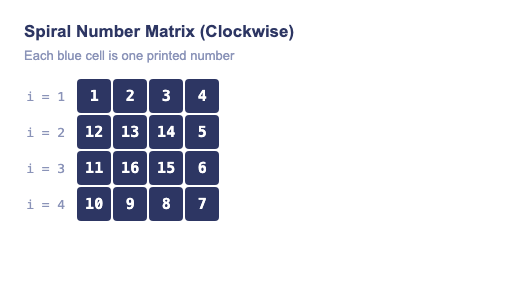
How the spiral number matrix works
Keep four boundaries: top, bottom, left and right. Fill the top row left to right, the right column top to bottom, the bottom row right to left and the left column bottom to top, shrinking the matching boundary after each side. Stop when the boundaries cross, then print the matrix.
Spiral Number Matrix in C
#include <stdio.h>

int main(void) {
    int n = 4;
    int a[n][n];
    int top = 0, bottom = n - 1, left = 0, right = n - 1;
    int value = 1;

    while (top <= bottom && left <= right) {
        for (int j = left; j <= right; j++)
            a[top][j] = value++;
        top++;
        for (int i = top; i <= bottom; i++)
            a[i][right] = value++;
        right--;
        if (top <= bottom) {
            for (int j = right; j >= left; j--)
                a[bottom][j] = value++;
            bottom--;
        }
        if (left <= right) {
            for (int i = bottom; i >= top; i--)
                a[i][left] = value++;
            left++;
        }
    }

    for (int i = 0; i < n; i++) {
        for (int j = 0; j < n; j++)
            printf("%3d", a[i][j]);
        printf("\n");
    }
    return 0;
}
Spiral Number Matrix in C++
#include <iostream>
#include <iomanip>
#include <vector>
using namespace std;

int main() {
    int n = 4;
    vector<vector<int>> a(n, vector<int>(n));
    int top = 0, bottom = n - 1, left = 0, right = n - 1;
    int value = 1;

    while (top <= bottom && left <= right) {
        for (int j = left; j <= right; j++)
            a[top][j] = value++;
        top++;
        for (int i = top; i <= bottom; i++)
            a[i][right] = value++;
        right--;
        if (top <= bottom) {
            for (int j = right; j >= left; j--)
                a[bottom][j] = value++;
            bottom--;
        }
        if (left <= right) {
            for (int i = bottom; i >= top; i--)
                a[i][left] = value++;
            left++;
        }
    }

    for (int i = 0; i < n; i++) {
        for (int j = 0; j < n; j++)
            cout << setw(3) << a[i][j];
        cout << endl;
    }
    return 0;
}
Spiral Number Matrix in Java
public class SpiralNumberMatrix {
    public static void main(String[] args) {
        int n = 4;
        int[][] a = new int[n][n];
        int top = 0, bottom = n - 1, left = 0, right = n - 1;
        int value = 1;

        while (top <= bottom && left <= right) {
            for (int j = left; j <= right; j++)
                a[top][j] = value++;
            top++;
            for (int i = top; i <= bottom; i++)
                a[i][right] = value++;
            right--;
            if (top <= bottom) {
                for (int j = right; j >= left; j--)
                    a[bottom][j] = value++;
                bottom--;
            }
            if (left <= right) {
                for (int i = bottom; i >= top; i--)
                    a[i][left] = value++;
                left++;
            }
        }

        for (int i = 0; i < n; i++) {
            for (int j = 0; j < n; j++)
                System.out.printf("%3d", a[i][j]);
            System.out.println();
        }
    }
}
Spiral Number Matrix in Python
n = 4
a = [[0] * n for _ in range(n)]
top, bottom, left, right = 0, n - 1, 0, n - 1
value = 1

while top <= bottom and left <= right:
    for j in range(left, right + 1):
        a[top][j] = value
        value += 1
    top += 1
    for i in range(top, bottom + 1):
        a[i][right] = value
        value += 1
    right -= 1
    if top <= bottom:
        for j in range(right, left - 1, -1):
            a[bottom][j] = value
            value += 1
        bottom -= 1
    if left <= right:
        for i in range(bottom, top - 1, -1):
            a[i][left] = value
            value += 1
        left += 1

for i in range(n):
    for j in range(n):
        print(f"{a[i][j]:3d}", end="")
    print()
Time and space complexity
Every cell is filled once and printed once, so the program runs in O(n²) time. It stores the whole n × n matrix, so it uses O(n²) memory.