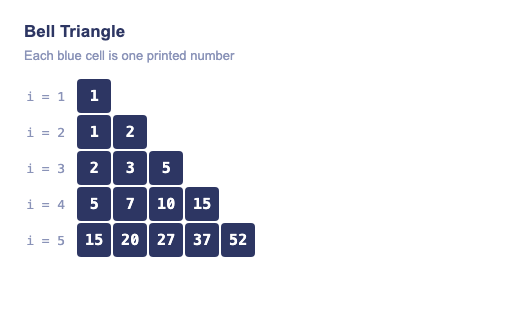
The Bell triangle, also known as Aitken’s array or the Peirce triangle, produces the Bell numbers 1, 2, 5, 15, 52 along its right edge. Every row starts with the last number of the row above.
Quick answer: Keep the previous row in an array. A new row starts with the last number of the previous row. Each next number is its left neighbour plus the number above that neighbour: cur[j] = cur[j − 1] + prev[j − 1]. The row grows by one number each time.
This program is part of the Series Patterns collection.
Table of contents8 sections
Bell Triangle output
Output (n = 5):
  1
  1  2
  2  3  5
  5  7 10 15
 15 20 27 37 52
How the bell triangle works
The rule is simple once you see it on paper. Row 3 starts with 5, the last number of row 2. The next number is 5 plus the 2 above that 5, which is 7. Then 7 plus the 3 above it gives 10, and 10 plus 5 gives 15. The program does exactly this with two arrays: prev holds the row above and cur is being built. After printing, cur is copied into prev for the next row.
- Print the first row, which is just 1, and store it in
prev. - For
ifrom 1 ton − 1: setcur[0] = prev[i − 1]. - For
jfrom 1 toi, setcur[j] = cur[j − 1] + prev[j − 1]. - Print
cur[0]tocur[i], copy them intoprev, and move to the next line.
Key takeaways
- Each row starts where the last one ended.
- Every other number is its left neighbour plus the number above that neighbour.
- Both edges carry the Bell numbers: 1, 1, 2, 5, 15 on the left and 1, 2, 5, 15, 52 on the right.
- Two arrays, one for the old row and one for the new, are all the memory the program needs.
Bell Triangle in C
#include <stdio.h>

int main(void) {
    int n = 5;
    int prev[20], cur[20];
    prev[0] = 1;
    printf("%3d\n", 1);

    for (int i = 1; i < n; i++) {
        cur[0] = prev[i - 1];
        for (int j = 1; j <= i; j++)
            cur[j] = cur[j - 1] + prev[j - 1];
        for (int j = 0; j <= i; j++) {
            printf("%3d", cur[j]);
            prev[j] = cur[j];
        }
        printf("\n");
    }
    return 0;
}Bell Triangle in C++
#include <iostream>
#include <iomanip>
#include <vector>
using namespace std;

int main() {
    int n = 5;
    vector<int> prev(n), cur(n);
    prev[0] = 1;
    cout << setw(3) << 1 << endl;

    for (int i = 1; i < n; i++) {
        cur[0] = prev[i - 1];
        for (int j = 1; j <= i; j++)
            cur[j] = cur[j - 1] + prev[j - 1];
        for (int j = 0; j <= i; j++) {
            cout << setw(3) << cur[j];
            prev[j] = cur[j];
        }
        cout << endl;
    }
    return 0;
}Bell Triangle in Java
public class BellTriangle {
    public static void main(String[] args) {
        int n = 5;
        int[] prev = new int[n], cur = new int[n];
        prev[0] = 1;
        System.out.printf("%3d%n", 1);

        for (int i = 1; i < n; i++) {
            cur[0] = prev[i - 1];
            for (int j = 1; j <= i; j++)
                cur[j] = cur[j - 1] + prev[j - 1];
            for (int j = 0; j <= i; j++) {
                System.out.printf("%3d", cur[j]);
                prev[j] = cur[j];
            }
            System.out.println();
        }
    }
}Bell Triangle in Python
n = 5
prev = [1]
print(f"{1:3d}")

for i in range(1, n):
    cur = [prev[-1]]
    for j in range(1, i + 1):
        cur.append(cur[j - 1] + prev[j - 1])
    print("".join(f"{x:3d}" for x in cur))
prev = curTime and space complexity
Row i takes O(i) additions, so the program runs in O(n²) time and uses O(n) memory for the two arrays.
Frequently asked questions
What do Bell numbers count?
The number of ways to split a set into groups. Three people can be grouped in 5 ways: all together, all apart, or one of three different pairs plus a single person. That 5 is the Bell number at the end of row 2.
Can I do it with one array?
Not easily, because each new value needs the old value at position j − 1, which the same pass has just overwritten. Two arrays keep the code clear; the extra memory is only O(n).
How is it different from Pascal’s triangle?
In Pascal’s triangle every row starts with 1 and each number adds the two numbers above it. In the Bell triangle each row starts with the last number of the previous row and the sums go along the row, so the numbers grow much faster.