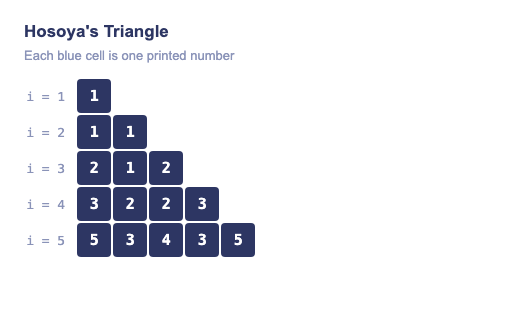
Hosoya’s triangle, sometimes called the Fibonacci triangle in Pascal form, is built from products of Fibonacci numbers. Its outer edges are the Fibonacci series, 1 1 2 3 5, and every row reads the same forwards and backwards.
Quick answer: Fill an array with the Fibonacci numbers, F(1) = F(2) = 1. Number j in row i (both counted from 0) is F(j + 1) × F(i − j + 1). Row 4, for example, is F(1)×F(5), F(2)×F(4), F(3)×F(3), F(4)×F(2) and F(5)×F(1), which gives 5 3 4 3 5.
This program is part of the Series Patterns collection.
Table of contents8 sections
Hosoya’s Triangle output
Output (n = 5):
  1
  1  1
  2  1  2
  3  2  2  3
  5  3  4  3  5
How the hosoya’s triangle works
The triangle was described by the chemist Haruo Hosoya. You can build it with a Pascal-like addition rule, but the product formula is easier to code: the left edge (j = 0) is F(1) × F(i + 1), which is just the Fibonacci series, and the right edge is the same by symmetry. Swapping j and i − j swaps the two factors, so each row is a palindrome.
- Fill
fib[1]tofib[n + 1]with the Fibonacci numbers, starting 1, 1. - Run the outer loop for
ifrom 0 ton − 1. - For
jfrom 0 toi, printfib[j + 1] × fib[i − j + 1]three characters wide. - Move to the next line.
Key takeaways
- Every number is a product of two Fibonacci numbers.
- The left and right edges are the Fibonacci series itself.
- Each row is a palindrome, because swapping
jandi − jswaps the two factors. - Computing the Fibonacci numbers once, before the loops, keeps the inner loop to a single multiplication.
Hosoya’s Triangle in C
#include <stdio.h>

int main(void) {
    int n = 5;
    int fib[20];
    fib[1] = fib[2] = 1;
    for (int k = 3; k <= n + 1; k++)
        fib[k] = fib[k - 1] + fib[k - 2];

    for (int i = 0; i < n; i++) {
        for (int j = 0; j <= i; j++)
            printf("%3d", fib[j + 1] * fib[i - j + 1]);
        printf("\n");
    }
    return 0;
}Hosoya’s Triangle in C++
#include <iostream>
#include <iomanip>
#include <vector>
using namespace std;

int main() {
    int n = 5;
    vector<int> fib(n + 2, 1);
    for (int k = 3; k <= n + 1; k++)
        fib[k] = fib[k - 1] + fib[k - 2];

    for (int i = 0; i < n; i++) {
        for (int j = 0; j <= i; j++)
            cout << setw(3) << fib[j + 1] * fib[i - j + 1];
        cout << endl;
    }
    return 0;
}Hosoya’s Triangle in Java
public class HosoyasTriangle {
    public static void main(String[] args) {
        int n = 5;
        int[] fib = new int[n + 2];
        fib[1] = fib[2] = 1;
        for (int k = 3; k <= n + 1; k++)
            fib[k] = fib[k - 1] + fib[k - 2];

        for (int i = 0; i < n; i++) {
            for (int j = 0; j <= i; j++)
                System.out.printf("%3d", fib[j + 1] * fib[i - j + 1]);
            System.out.println();
        }
    }
}Hosoya’s Triangle in Python
n = 5
fib = [0, 1, 1]
for k in range(3, n + 2):
    fib.append(fib[k - 1] + fib[k - 2])

for i in range(n):
    for j in range(i + 1):
        print(f"{fib[j + 1] * fib[i - j + 1]:3d}", end="")
print()Time and space complexity
Building the Fibonacci array takes O(n) time and memory, and printing the triangle takes O(n²) time.
Frequently asked questions
Is there an addition rule like Pascal’s triangle?
Yes. Away from the edges, each number equals the sum of the two numbers above it on the same side, two rows up and one row up: H(i, j) = H(i − 1, j) + H(i − 2, j). The product formula gives the same values and is simpler to write.
Why is it called a Fibonacci triangle?
Because its edges are the Fibonacci series and every entry is made from Fibonacci numbers. Do not mix it up with the Fibonacci triangle on this site, which just prints the series row by row.
How large can n get?
The biggest number in row i is on the edge, F(i + 1), so overflow comes from the Fibonacci numbers themselves. An int is safe up to row 45; use a 64-bit type for more.