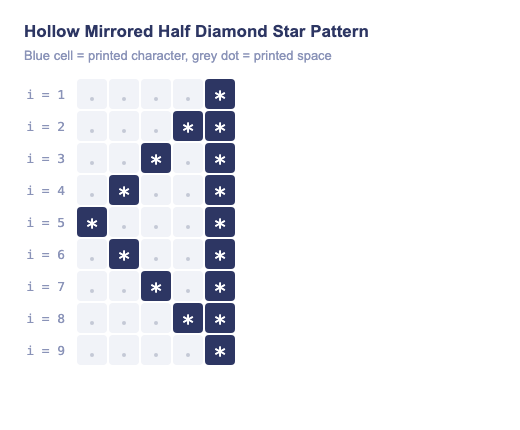
The hollow mirrored half diamond star pattern has a straight right edge and a slanted left edge that points out to the left. It is the outline of the mirrored half diamond, also known as the hollow left Pascal’s triangle.
Quick answer: Give every row n positions and print a star only at the slanted edge, j == n − i + 1, and the straight edge, j == n. Do this for rows 1 to n, then for rows n − 1 down to 1.
This program is part of the Star Patterns collection.
Table of contents8 sections
Hollow Mirrored Half Diamond Star Pattern output
Output (n = 5):
    *
   **
  * *
 *  *
*   *
 *  *
  * *
   **
    *
How the hollow mirrored half diamond star pattern works
Making every row the full width n lines up the right edge without separate space loops. The positions before n − i + 1 fail the test and come out as spaces, which act as the indent. Between the two edges the test also fails, so those positions become the hollow inside.
- Run the outer loop for
ifrom1ton, one row per pass (upper half). - Go through
npositions in the row. Print stars wherej = n or j = n − i + 1; print spaces everywhere else. - Move to the next line.
- Run the outer loop for
ifromn − 1down to1, one row per pass (lower half). - Go through
npositions in the row. Print stars wherej = n or j = n − i + 1; print spaces everywhere else. - Move to the next line.
Key takeaways
- Every row is
npositions wide, so the right edge stays straight. - The slanted edge is at
j == n − i + 1; it moves left by one each row. - Leading spaces and the inside gap both come from the same failed test.
- Mirroring a left-aligned pattern means replacing
jwithn − j + 1in its conditions.
Hollow Mirrored Half Diamond Star Pattern in C
#include <stdio.h>

int main(void) {
    int n = 5;

    // upper half
    for (int i = 1; i <= n; i++) {
        for (int j = 1; j <= n; j++) {
            if (j == n || j == n - i + 1)
                printf("*");
            else
                printf(" ");
        }
        printf("\n");
    }

    // lower half
    for (int i = n - 1; i >= 1; i--) {
        for (int j = 1; j <= n; j++) {
            if (j == n || j == n - i + 1)
                printf("*");
            else
                printf(" ");
        }
        printf("\n");
    }
    return 0;
}Hollow Mirrored Half Diamond Star Pattern in C++
#include <iostream>
using namespace std;

int main() {
    int n = 5;

    // upper half
    for (int i = 1; i <= n; i++) {
        for (int j = 1; j <= n; j++) {
            if (j == n || j == n - i + 1)
                cout << "*";
            else
                cout << " ";
        }
        cout << endl;
    }

    // lower half
    for (int i = n - 1; i >= 1; i--) {
        for (int j = 1; j <= n; j++) {
            if (j == n || j == n - i + 1)
                cout << "*";
            else
                cout << " ";
        }
        cout << endl;
    }
    return 0;
}Hollow Mirrored Half Diamond Star Pattern in Java
public class HollowMirroredHalfDiamondStar {
    public static void main(String[] args) {
        int n = 5;

        // upper half
        for (int i = 1; i <= n; i++) {
            for (int j = 1; j <= n; j++) {
                if (j == n || j == n - i + 1)
                    System.out.print("*");
                else
                    System.out.print(" ");
            }
            System.out.println();
        }

        // lower half
        for (int i = n - 1; i >= 1; i--) {
            for (int j = 1; j <= n; j++) {
                if (j == n || j == n - i + 1)
                    System.out.print("*");
                else
                    System.out.print(" ");
            }
            System.out.println();
        }
    }
}Hollow Mirrored Half Diamond Star Pattern in Python
n = 5

# upper half
for i in range(1, n + 1):
    for j in range(1, n + 1):
        if j == n or j == n - i + 1:
            print("*", end="")
        else:
            print(" ", end="")
    print()

# lower half
for i in range(n - 1, 0, -1):
    for j in range(1, n + 1):
        if j == n or j == n - i + 1:
            print("*", end="")
        else:
            print(" ", end="")
print()Time and space complexity
The program prints one character for each position in the pattern, so for n rows it runs in O(n²) time. It only needs a few loop variables, so the extra memory is O(1).
Frequently asked questions
How do I get the version that points right?
Use the hollow half diamond: print stars at j == 1 and j == i on rows of i positions.
Why not print the spaces in a separate loop?
You can: print n − i spaces, then a hollow row of i positions. Testing the full width in one loop is shorter and makes the mirror rule easy to see.
Can I make it solid again?
Change the condition to j >= n − i + 1. Every position from the slanted edge to the right edge then gets a star.